What actually is Permaculture?
Written by Toad
Edited by Guy
So, you might’ve heard the term permaculture come up at a gardening club, a community garden or maybe even a social change event. It may have been mentioned with a smile or a condescending side-eye or more than likely some sense of befuddlement. Usually everyone there might have some idea of what permaculture is but when you ask for a definition you typically get a variety of answers from “some kind of organic farming” and “permanent culture” to “it’s something about living an Amish lifestyle right?” and usually I can’t fault them because to some degree, their answers carry some grain of truth. Permaculture itself is pulled from various schools of thought such as systems thinking, ecology, land management, First Nations wisdom* (both stolen and given - This will be another article), energy descent and pattern language, just to name a few! What was once a design approach for creating regenerative and “permanent agriculture”, permaculture has evolved as new people, new ideas and broader concepts that recognise how this design methodology impacts social and economic systems continues to shape and grow the movement and design process.
So to be perfectly clear: people are often very unclear about what permaculture is. So, what is permaculture?
The definition of permaculture we use here at PermaQueer is:
“A design methodology underpinned by core ethics and systems thinking that uses design principles that can be applied to social, economic and ecological systems to meet the needs of all (people and otherwise) within planetary boundaries”
And that’s just our definition, you get to asking teachers and community leaders within the permaculture movement and you get as many variations to this answer as varieties of trees in their bioregion. If I’m honest, that’s not always a bad thing. Now why is that not a bad thing? Well in my understanding permaculture is profoundly contextual and relational and what I mean by that is your personal circumstances, the bioregion, communities and cultures you exist within influence how you practice permaculture. The permaculture I practice in urban spaces to uplift and support queer and other vulnerable communities is going to look wildly different to Steve Farmer who lives rurally and is focused on trying to live sustainably with his family.
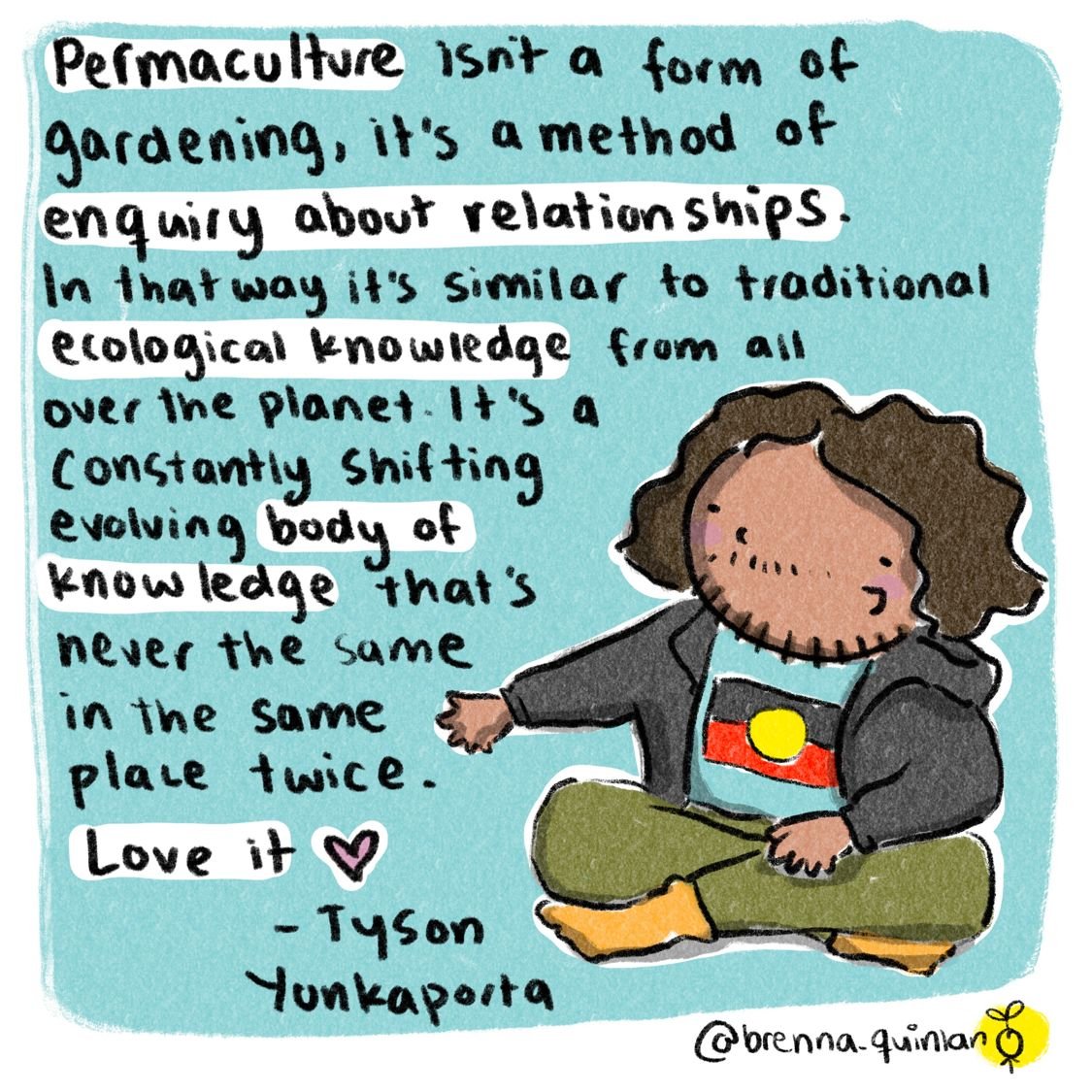
Artwork by permaculture illustrator Brenna Quinlan
So if we can see that permaculture is practiced in wildly different ways, is everything “regenerative” or “eco-friendly” permaculture then?
Well… no
To actually address what permaculture is means to look at the one thing people in permaculture (mostly) agree on, the permaculture ethics. The ethics can be considered as almost the DNA of what is and is not a permaculture design. These are:

To learn even more, check out Here
Earth Care: restoring Nature’s capital
People Care: care of self, kin and community
Fair Share: Set limits and redistribute the surplus
Whether you use design principles by Bill Mollison, David Holmgren or Meg McGowan, we cannot call a design or a system permaculture if it does not embody all three ethics. The design principles and the tools used can be considered the “how to” of permaculture but the ethics always remain the “what is” of Permaculture. When things are as theoretical as this, it’s useful to have some examples for what is and what is not permaculture according to this rubric.
A few things that could be called Permaculture Designs
-
I’ve seen and been a part of some incredible communities that divest waste from landfill through a dumpster diving network. Both feed themselves and share the surplus around to other members of the community. In fact, during the Covid lockdowns in Naarm (so-called Melbourne) our household paid virtually no money for food through dumpster diving and also helped run a food distribution network called “food is free '' in our suburbs that fed a number of low income and vulnerable people. So what makes this a permaculture design apart from being run by permaculture designers? Well, apart from implementing a few permaculture principles such as “produce no waste” let’s have a closer look at the ethics behind this design.
Earth Care: Divesting organic waste from landfill and processing the plastic waste appropriately
People Care: Feeding the dumpster divers, their housemates & communities and lowering their cost of living
Fair Share: Redistributing excess food to vulnerable communities during Covid lockdowns and setting up a food is free cabinet within their community to share food & resources locally
-
Verge gardens are a fantastic way to introduce new people to the concept of permaculture. They’re great for slowing the cities down and acting as conversation pieces as well to build relationships with the neighbours, one thing to consider though is to make sure that your verge garden isn’t affecting the accessibility or visibility of paths for our neighbours who need it. The most brilliant part of these designs is the minute one person creates one, it gives the whole street permission to start their own!
Earth Care: pollinators planted instead of grass to be mown. Sequesters more carbon, provides habitat and food for insects and helps supports more diversity of life for your neighbourhood ecosystem.
People Care: Food plants & bush tucker available to community members and beautification of the neighbourhood (although that is subjective)
Fair Share: by having this garden open and accessible on the verge and not just on private land, the benefits and yields are accessible to all.
-
There’s a number of socially and ecologically conscious farms popping up in rural and urban spaces around so-called Australia such as Joe’s Market Garden in Naarm and Loop Growers in Samford. Though these enterprises might not explicitly be permaculture design, what is exciting is how they do meet the criteria for the permaculture ethics. Many permaculture designers are picking up this model and implementing it in their own areas.
Earth Care: Growing food locally and ethically reduces food miles and helps increase biodiversity in your area instead of decreasing it. Many farms also divest organic waste from cafe’s cycling it into a valuable soil & compost product, not simply a wasteful problem.
People Care: Providing access to locally grown, delicious nutrient dense & ethical food as well as providing employment, education and local opportunities.
Fair Share: Running a business through a social enterprise model can help balance people and profit, by having community outreach and education programs social enterprises can act as a force of good in their communities.
-
A permaculture design course (or a PDC for short) can be one of the most transformative experiences where you learn with a cohort of fellow community members about systems thinking, design frameworks, ecology, water systems, social and economic paradigms and how one can implement their own permaculture designs! I’ve seen some brilliant designs come out of PDC’s that end up implemented and supported by everyone in that class. PDC’s often differ from teacher to teacher and bioregion to bioregion as the needs of the students and restrictions of the environment can determine how the course is delivered. In fact, as a teacher you can design your PDC to be a permaculture design in itself!
Earth Care: Teaching students about ecology, water and soil systems can empower students to build designs and engage in practices that help reduce waste and restore their local & global ecosystems. By including practical hands-on activities students get involved in projects that engage in active Earth care & regeneration.
People Care: The PDC content helps students create systems that support both people and the planet. When our PDC content is designed with physically accessible, trauma & neurodivergent informed practices, interculturally competent design and allows students time to integrate the content in a way that works for them, we foster deep care for others and spaces where deep care systems can be created.
Fair Share: All teachers should include a sliding scale, work-exchange, subsidisation or scholarship options for students to equitably access this content no matter their financial resources.
-
Permaculture can be applied in the most displaced environments. This is well seen in the incredible work of Permaculture for Refugees and the Ethos Foundation. Food scarcity, conflict and poor access to housing are just a few of the many issues people in refugee camps face. Permaculture education can be a great tool to help build food security, water management, conflict resolution processes, governance tools and technologies for resourceful housing. Here are some of the ways that these meet the permaculture ethics.
Earth Care: Providing education and support that creates local, regenerative and sovereign food systems adaptive to changing and uncertain circumstances.
People Care: By providing education and resources permaculture can assist people to self determine systems that meet their needs with dignity & agency.
Fair Share: Ensuring the educational content is free and engages community leaders the real value of permaculture design can be distributed across the community by supporting these leaders to reframe the content and design systems that are relevant, self determined, culturally appropriate and provide ongoing value for their communities.
So it’s pretty exciting then how broad and adventurous we can get when it comes to permaculture. We can keep our designs within the bounds of our gardens but things get infinitely more exciting, collaborative and successful when we start to dream out beyond the barriers of our garden walls. What would it look like to dream of a future where we pulled our fences down? A future where we set up collaborative food systems with neighbours, collaborative child caring, co-cops and tool libraries? Permaculture is a great tool of self sufficiency (although it’s something I often reframe as “selfish sufficiency” given we’re all connected somehow) but permaculture shines when we design collaboratively, for our neighbourhoods, our communities and our larger society.

The Permaculture Flower as designed by David Holmgren on the seven domains of permaculture action that permaculture designers need to consider.
So, I obviously get very excited about the capacity of the breadth of permaculture to do amazing things for people and the planet! Although It’s very important we take off our rose tinted glasses and acknowledge that not everything that calls itself regenerative or permaculture actually is permaculture. As mentioned before, permaculture is a design methodology and given its diverse practices and implementations (a huge strength of permaculture) we need to become very discerning about whether what we’re looking at is indeed permaculture or not. Given the growing awareness and interest in permaculture we’re seeing a lot of pseudo-regenerative projects with very good intentions claiming the title of permaculture when it is not always appropriate or accurate. If in doubt I always refer back to the ethics to confirm. Here’s a few examples of things I wouldn’t necessarily call permaculture.
Things we cannot call permaculture designs
-
It may seem odd I’ve put a PDC here as well as something that isn’t necessarily permaculture but stay with me for a second. We can only claim something is permaculture if it meets the permaculture ethics. We can’t simply rely on the educational content alone as the delivery has to be ethical too. As mentioned before, a PDC can be taught in a variety of different ways by a number of different teachers. So if that is the case, what are some PDC’s that might not actually be permaculture from an ethical standpoint?
Earth Care: As mentioned earlier, permaculture is a design methodology, not simply a string of regenerative farming techniques. Unfortunately a number of courses market themselves as permaculture but provide a series of gardening techniques with little mention of the ethics or other key components. We cannot say a PDC is practicing earth care either if the techniques taught are not relevant for the bioregion or even actively harmful to the environment.
People Care: If the content is delivered in a hostile social environment where various forms of prejudice are allowed to be unchecked (such as misogyny, homophobia, transphobia, racism, ableism etc) and other practices such as bullying are allowed. We cannot say that this PDC is practicing people care.
Fair Share: If a course is not engaging in sliding scales for payment, providing scholarships or practicing some method of redistributing the surplus either through delivery of content or financial remunerations back into community, we cannot say a PDC is practicing fair share.
-
So this is becoming a more & more frequent occurrence. We’re seeing well intentioned people, usually wealthy and white from the global north, take those resources and start “regenerative” communities in places like Portugal, Costa Rica, Bali, Papua New Guinea, etc with huge impacts on the local environments and communities. I’ve seen some emerge that have a really collaborative approach and positive influence but unfortunately these aren’t as common as you might hope. A lot of these institutions and communities have “permaculture” in the name, but let’s look at the ethics.
Earth Care: The first question we need to ask is what is the environmental impact of these farms and communities? Was this previously untouched environment or lands stewarded by indigenous communities that the government bulldozed to attract wealthy expats? How is the community or farm acquiring its resources, are they creating a local hub of “regeneration” at the expense of dumping waste or creating environmental issues out of their own line of sight?
People Care: It’s also important to discus which group of people it is caring for, and is it doing so at the expense of another? Is the creation of this kind of space pushing out local and vulnerable communities and by doing so gentrifying the area?
Fair Share: This is where I often see the ball dropped the most. In attempting to care for one small patch of environment and one small typically wealthy expat community the other environments and wider communities and economies suffer. If our pleasure and success is off of the disadvantage of others, we cannot call our communities permaculture designed.
-
So the context here is we saw a “permaculture” garden at a music festival and well… it wasn’t exactly permaculture in practice. The garden itself was a number of pansies planted into the ground in the outback of Australia, backfilled with plastic aquarium rocks to spell out the word “permaculture”. Apart from the literal word permaculture, I can’t say how else it related to permaculture. Let’s have a look at the ethics.
Earth Care: Plastic rocks are a huge environmental waste and pansies are an introduced species that if left out untended in the Australian bush could become invasive (not that I expected them to survive under the harsh sun).
People Care: Now you could argue that the design brings “beauty” for the people walking by but doesn’t provide any other clear benefit and beauty alone does not make people care.
Fair Share: Is entirely unclear how this design might embody fair share but hey, if you can think of a few ways please let me know!
Pretty sneaky right?
When we start to think in terms of systems design and begin to question the underlying ethics and outcomes, our regenerative influence continues to build. In saying that, things that wouldn’t be considered permaculture on their own can still be built into a permaculture system. For example you may be taking a permaculture design approach to a start up farm and use syntropic agroforestry and sociocracy as elements in your system to serve the function of meeting your Earth Care and People Care ethics. These elements themselves aren’t inherently permaculture, in fact usually exist in very different worlds, but may be used amongst other frameworks, technology and tools in your permaculture design. Permaculture is the art of weaving various elements together into designs that meet your needs in ethical and regenerative ways. Some of the most effective permaculture designs I’ve seen implemented have incorporated elements of syntropic agroforestry, verge gardens, dumpster diving, trauma informed design, sociocracy and the Local Energy Transfer System (LETS).
To sum things up, permaculture is more than the sum of its parts, it’s the intentional design of relationships between seemingly incongruent elements into something that achieves ethical outcomes for people and planet in equitable ways. Permaculture can be practiced in wildly different ways in wildly different worlds. From your backyard, to refugee camps to even policy & governance design. Part of the great joy of permaculture is learning how it can be applied in your context and discovering what permaculture might look like in your hands.
In future blog posts we’ll be having a deeper look into permaculture in all its facets: from the history of permaculture and the complex (at times extractive and colonial and at other times collaborative) relationships it has had with First Nations People, to systems thinking, queer theory and the ways it is continually innovated upon as an organic, growing movement.

* Permaculture is not exempt from the context of white settler colonialism it exists within. Permaculture is a decentralised movement and many ideas, technologies and methodologies carried in its practice have had varying levels of reference and credit as to their sources. We understand that Australian First Nations people & practices influenced part of Bill Mollison’s life & thinking as seen through his references in Permaculture 2 and the Designers Manual. We have a critical role and responsibility to platform Indigenous voices when discussing Indigenous knowledge, to be good ally’s in the protection & non proliferation of their sacred knowledge & recognise their intellectual property not for colonial consumption or distribution. We also have a responsibility to use sound ecological & social design in addition with the privilege, capital and resources we have to reconcile & regenerate the harms caused by colonisation. Permaculture is a design methodology born of the need to regenerate through colonialism's failures and is fit for this purpose. It is a powerful stepping stone forward, however, it must not be mistaken for the destination. When and where we can we seek consent, tag credit, reference & lineage as to where knowledge has come from and ensure these communities whose knowledge are being used benefit from the abundance created in using them.